

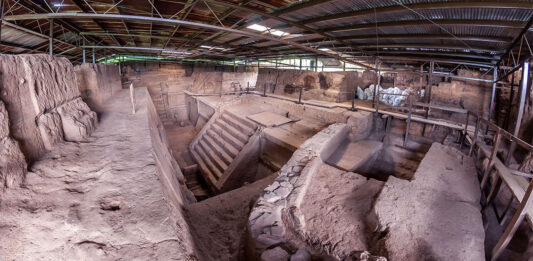
Much of the Guatemalan highlands contains archaeological remains of populations that have not been able to be related to current Mayan groups. Such is the case of Kaminaljuyu, located in Guatemala City and the largest pre-Hispanic settlement in the Highlands. It was occupied since the Middle Preclassic and was abandoned at the end of the Late Classic.
Originally it had 260 buildings made of earth and mud, placed around a now extinct lake, but the expansion of the city has almost completely destroyed them, since only about 20 buildings remain in the small Kaminaljuyu Archaeological Park and some mounds between houses. .
It had its heyday in the Late Preclassic, as evidenced by the presence of elaborate tombs and a large number of sculptures, some of which have hieroglyphic inscriptions. Its hydraulic works also stand out, including the Mound of the Culebra, which is an aqueduct more than 4 km long.
Already during the Early Classic period it had strong influences from Teotihuacán, evidenced by its Talud-tablero style architecture made of clay. Kaminaljuyu's prosperity was surely due to its strategic position in the Guatemala Valley, which allowed it to control the trade of products such as jade, obsidian and cocoa to the Lowlands and other regions of Mesoamerica.
From Paxil, from Cayalá, so called, came the yellow ears and the white ears.
Popol Vuh

 EN
EN  ES
ES 