

The Apaneca region is a mountainous region of Ahuachapán that contains numerous natural attractions and an archaeological zone with important vestiges of the Preclassic period.
Highlights the site of Saint Leticia, located inside the hotel of the same name, where there are three sculptures of the "Barrigón" style, which was distributed mainly along the Pacific Coast and the Mayan Altiplano at the beginning of the Late Preclassic, although some examples have appeared in other more distant places such as Tikal .
The archaeological site is characterized by its location on the slope of the Apaneca mountain, with a main plaza that was built using a large terrace. Structures 1 and 2 delimit the plaza on its north and west sides, while the three sculptures or "bellies" are aligned at the east end of the plaza, on a north-south axis.
Structure 3, located on a higher terrace, is the largest building on the site. Monument 1 is the largest, while Monument 2 is divided into two halves.
Like all sculptures of this style, the three paunchy figures of Santa Leticia show features of obese people and have their eyes closed and their arms down, in a flaccid manner. Their most visible feature is the prominent disc-shaped navels.
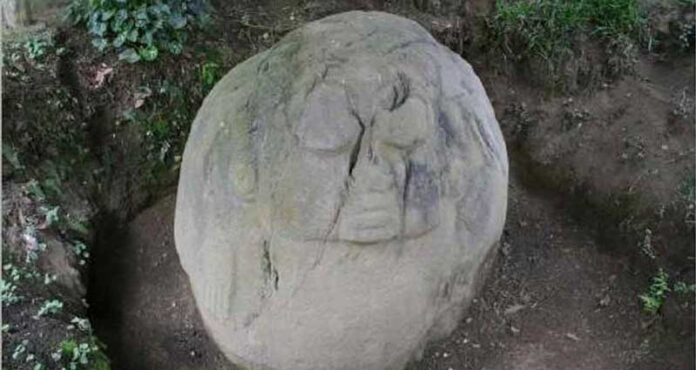
A stela and three sculptures of the "jaguar heads" style were recently discovered in the town of Conception of Ataco, which are exhibited in the municipal museum.
These sculptures are characterized by having features that combine human and feline elements, such as prominent front teeth, scroll-shaped eyebrows, mouths with upwardly twisted lips, and a dual symbolism that in some makes these faces asymmetrical.
All of this has been interpreted as part of a shamanic cult, where the man-jaguar duality alludes to states of altered consciousness.
A flood was produced by the Heart of Heaven; A great flood formed, which fell on the heads of the stick figures.
Popol Vuh

 EN
EN  ES
ES 