

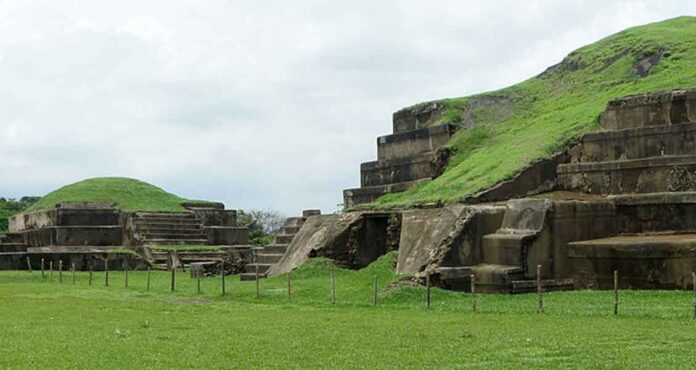
Another relevant archaeological zone of El Salvador apart from Chalchuapa, is the Zapotitán Valley, whose main center was the archaeological site Saint Andrew, located near the Sucio River.
Although there is evidence of its occupation from the Preclassic period, its main constructions date from the Late Classic, after the eruption of 536 AD. C. corresponding to the eruption of Ilopango.
Most buildings were built with adobe bricks as a core covered by layers of mortar. San Andrés has an Acropolis and to the north is The Great Plaza.
The Acropolis has Structure 1 inside, a pyramidal building 15 m high, where at least 4 construction stages can be seen. Three other small pyramids (structures 2, 3 and 4) stand in a row on the eastern side of the Acropolis.
The rest of the complex was closed on the west side by a row of rooms of perishable architecture, known as "The Chambers."
Structure 5 or the La Campana Pyramid is the largest building on the site and delimits the Great Plaza at its northeastern end. To the southeast of the Acropolis is Structure 7, which is the only one that presents tuff block masonry, inside which an offering with polychrome vessels, an eccentric flint offering, and other imported objects were found, indicating strong relationships with Copan. and the Mayan Lowlands.
There was nothing standing; only the water at rest, the peaceful sea, alone and calm. There was nothing endowed with existence.
Popol Vuh

 EN
EN  ES
ES 